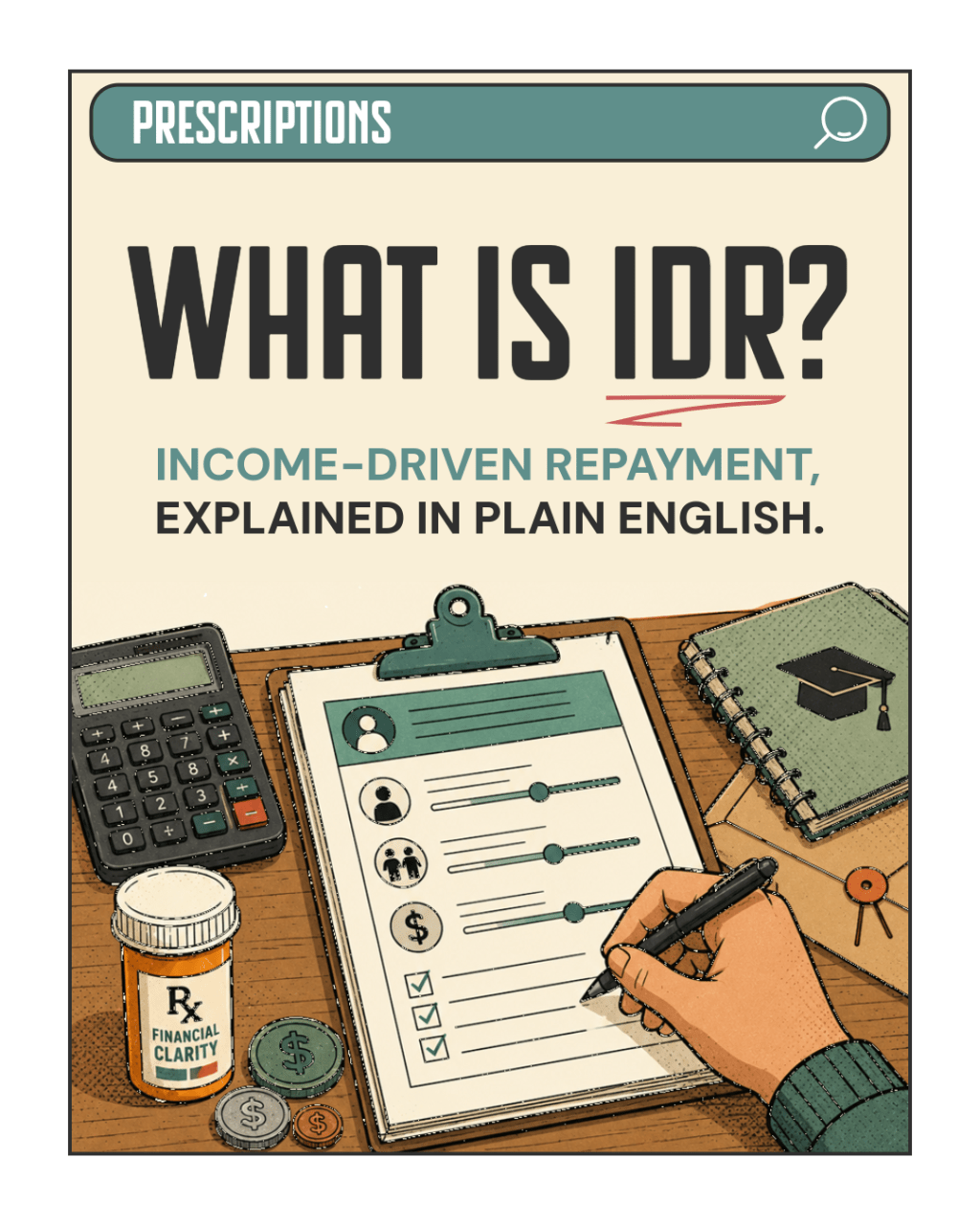
Student loan repayment has a talent for making simple words feel suspicious.
One of the biggest examples is IDR, which stands for income-driven repayment. It sounds helpful, but also vague enough to make you wonder if you accidentally enrolled in a government math club.
In plain English, IDR is a type of federal student loan repayment plan where your monthly payment is based mostly on your income and family size, not just how much you owe. Federal Student Aid says IDR plans can make payments more manageable by basing the payment on income and family size, and remaining balances may be forgiven after the repayment period ends.
That does not mean IDR is perfect. It can lower your payment, but it can also stretch repayment over many years, affect how much interest builds, and require regular income updates.
So let’s translate it.
IDR can make your monthly payment smaller, but smaller payments do not always mean your balance shrinks faster.
Symptom
You log into your student loan account and see repayment plan names like:
IBR
ICR
PAYE
SAVE
RAP
And suddenly it feels like the student loan system is trying to communicate through refrigerator magnets.
The symptom is repayment confusion.
You may be asking:
| Question | Why It Matters |
|---|---|
| What is IDR? | It may change how your payment is calculated. |
| Will it lower my payment? | Possibly, depending on income, family size, and loan type. |
| Will my balance still grow? | It can, especially if your payment does not cover interest. |
| Does it lead to forgiveness? | Some IDR plans include forgiveness after a set repayment period. |
| Do I have to update my income? | Usually, yes. IDR payments are recalculated over time. |
Diagnosis
IDR is not one plan. It is a category of repayment plans.
The current Federal Student Aid IDR FAQ lists several income-driven repayment plans, including Income-Based Repayment, Income-Contingent Repayment, and Pay As You Earn.
Here is the plain-English version:
| Plan | What It Means |
|---|---|
| IBR | Income-Based Repayment. Payment is generally based on a percentage of discretionary income. |
| ICR | Income-Contingent Repayment. Often relevant for certain consolidation situations, including some parent PLUS paths. |
| PAYE | Pay As You Earn. Payment is generally based on discretionary income and has specific borrower eligibility rules. |
| SAVE | A former repayment plan that has been ended by court order and is being phased out. |
| RAP | Newer repayment plan expected to become part of the repayment landscape, especially for borrowers leaving SAVE. |
The confusing part is that people often say “IDR” like it is one single thing.
It is not.
Saying “I’m on IDR” is like saying “I’m taking medicine.” Useful, but not specific enough to know the dose, side effects, or whether someone handed you the financial equivalent of horse antibiotics.
How IDR Payments Are Usually Calculated
IDR plans usually look at your income, family size, state, and loan type.
The key phrase is discretionary income.
That does not mean “money left after groceries, gas, rent, insurance, and the emotional support coffee you needed after opening your servicer account.”
For student loans, discretionary income is a formula. For IBR, servicer information describes it as the difference between your adjusted gross income and 150% of the poverty guideline amount for your family size and state.
A simplified example:
| Item | Example |
|---|---|
| Adjusted gross income | $40,000 |
| Protected income amount | $XX,XXX |
| Discretionary income | Income above that protected amount |
| IDR formula | A percentage of discretionary income |
| Monthly payment | Annual amount divided by 12 |
This is why two people with the same loan balance can have different payments.
Your loan balance matters, but under IDR, your income and family size can matter more.
What IDR Can Help With
IDR can be useful when your standard payment is too high compared with your income.
It may help if:
| Situation | Why IDR Might Help |
|---|---|
| Your income is low | Your payment may be reduced. |
| Your income changes | Payment may adjust when you recertify. |
| You have a large federal loan balance | Payment may be based on income instead of only balance. |
| You are pursuing forgiveness | IDR payments may count toward IDR forgiveness and possibly PSLF if other rules are met. |
| You need breathing room | A lower payment can help your monthly budget. |
This is the main reason people use IDR: it can make the monthly bill survivable.
A survivable bill is not a small thing. Sometimes the treatment plan is simply “stop the budget from catching fire.”
What IDR Does Not Automatically Fix
This is the part that gets borrowers.
A lower payment does not always mean your loan balance goes down quickly.
If your payment is less than the interest that builds, your balance may stay the same or grow, depending on the plan rules, subsidies, and whether unpaid interest is handled differently.
| IDR Side Effect | What It Means |
|---|---|
| Your payment may be lower | Good for cash flow. |
| Your repayment period may be longer | You may be in repayment for many years. |
| Interest may still matter | A low payment may not cover all interest. |
| Forgiveness may take time | Some IDR forgiveness periods are 20 or 25 years. |
| You may need annual updates | Income and family size usually need to be recertified. |
Federal Student Aid’s IDR FAQ notes that after borrowers complete the repayment period for each IDR plan, remaining balances are forgiven. The repayment period depends on the plan.
That is helpful, but it is not instant. IDR is often a long-term repayment structure, not a magic eraser with a login screen.
Treatment Plan
Before choosing or changing an IDR plan, check these things.
| Step | What to Do |
|---|---|
| Confirm your loan type | Not all loans qualify for every IDR plan. |
| Check your current plan | Know whether you are on IBR, ICR, PAYE, SAVE, or another plan. |
| Estimate your payment | Use official tools or your servicer before switching. |
| Look at interest | Ask whether your payment covers monthly interest. |
| Check forgiveness goals | PSLF and IDR forgiveness have different requirements. |
| Watch deadlines | Some plans and transitions have specific timelines. |
| Save every notice | Servicer messages are paperwork breadcrumbs. Keep them. |
If you are dealing with SAVE ending, be extra careful. Federal Student Aid’s current IDR request form notes that borrowers who take out a new loan or consolidate existing loans on or after July 1, 2026, will be required to repay Direct Loans under the forthcoming RAP or Tiered Standard Repayment Plan. It also notes PAYE and ICR borrowers must move to another plan before July 1, 2028.
Translation: student loan decisions can have weird trap doors. Read before clicking.
Things to Monitor
| What to Monitor | Why It Matters |
|---|---|
| Monthly payment | Shows what you owe each month. |
| Income recertification | Missing updates can change your payment. |
| Family size | Can affect payment calculations. |
| Interest accrual | Explains why balances may not fall. |
| Principal balance | Shows whether debt is shrinking. |
| Forgiveness count | Tracks progress toward IDR forgiveness or PSLF. |
| Servicer notices | Deadlines and plan changes may arrive by email or account message. |
| Tax filing status | Married borrowers may have different calculations depending on plan and tax filing. |
| Auto pay | A changed payment can affect automatic withdrawals. |
Final Diagnosis
IDR stands for income-driven repayment.
It is a category of federal student loan repayment plans that base your monthly payment mostly on income and family size. It can make payments more affordable, especially when your standard payment is too high for your budget.
But IDR is not automatically the cheapest or fastest way to repay student loans.
It can lower the monthly payment, stretch repayment over time, affect interest, and require regular updates. The best plan depends on your income, family size, loan type, forgiveness goals, and whether you need short-term breathing room or long-term payoff progress.
Final diagnosis: IDR can help lower the payment, but you still need to monitor the side effects.
 Side Effects Include Debt
Leave a comment