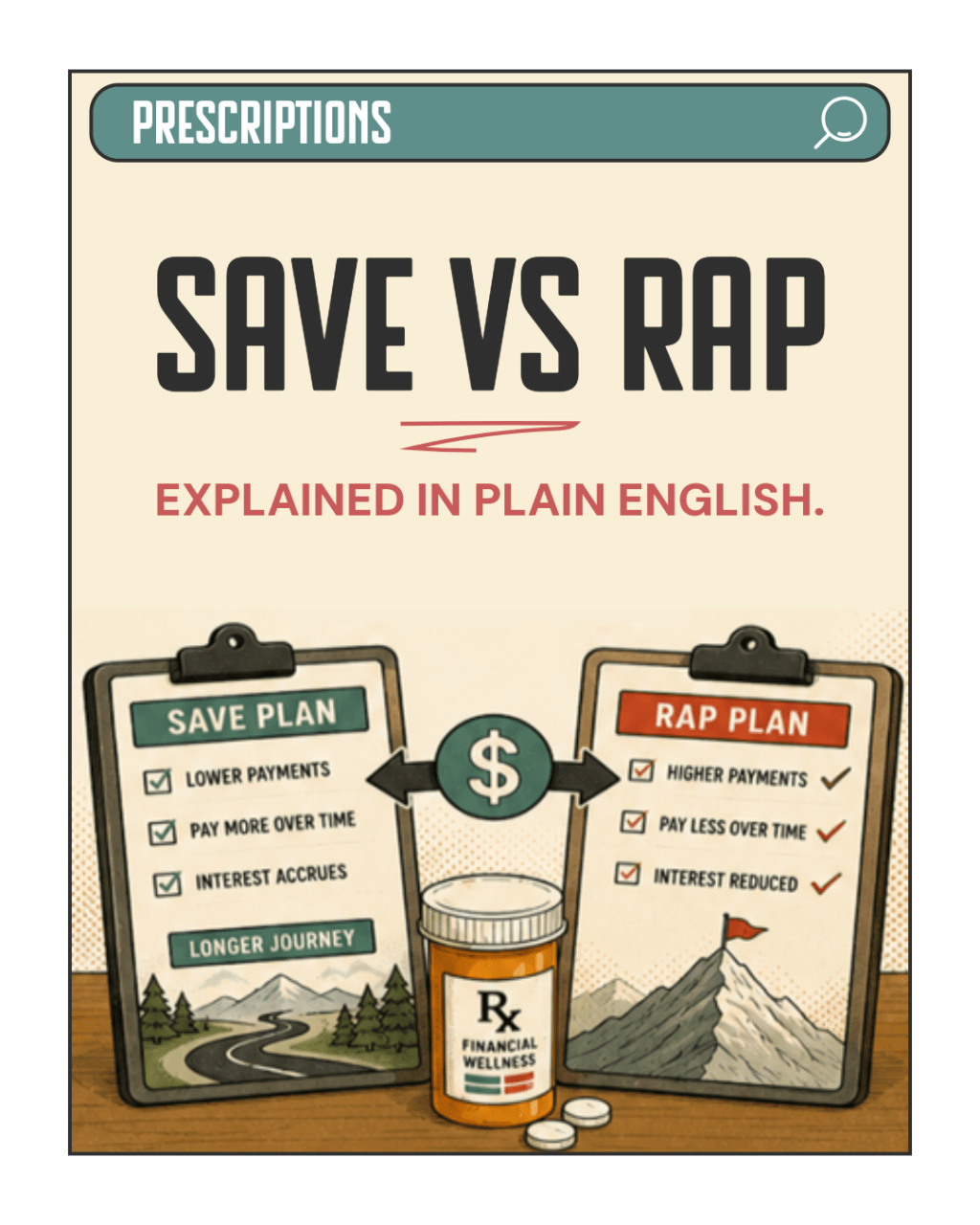
If you’ve tried reading official student loan repayment explanations lately, there’s a decent chance your eyes glazed over somewhere between “discretionary income calculation” and “income recertification.”
Student loan repayment plans are often explained like the reader already has a law degree, three spreadsheets open, and a personal relationship with federal regulations.
So let’s translate this into actual human language.
The SAVE Plan and RAP are both connected to the larger conversation around income-based student loan repayment. SAVE was the federal repayment plan that replaced REPAYE, but servicer notices now say a March 10, 2026 court order ended the SAVE Plan and that the Department of Education will contact affected borrowers. Federal Student Aid also says it is updating StudentAid.gov because significant repayment changes are underway.
RAP is newer and still needs to be watched carefully through official updates, because repayment information is changing fast. Which is a very calm way of saying: nobody needs another surprise loan notice showing up like a raccoon in the mailbox.
Symptom
You’re trying to figure out why your payment amount changed, whether SAVE still exists, what RAP means, which plan could lower your payment, whether forgiveness still applies, and whether you need to switch plans soon.
You may also feel like every article you read somehow answers none of those questions while still using 4,000 words.
That confusion makes sense. A lot of borrowers are trying to make decisions while the rules, timelines, and servicer messages keep shifting.
When repayment rules change faster than borrowers can understand them, confusion becomes part of the system.
Diagnosis
SAVE and RAP are not the same thing.
SAVE was an income-driven repayment plan. Income-driven repayment, or IDR, means your monthly payment is based on income and family size instead of only on how much you owe. Federal Student Aid explains that IDR payments may be lower when income goes down or family size goes up, but some IDR plans can also lead to more interest over time because smaller payments may stretch repayment out longer.
RAP, on the other hand, is part of the newer repayment-plan conversation borrowers are watching as SAVE ends and federal repayment options change. The important thing right now is not to assume every social media post, servicer rumor, or “student loan relief” phone call has the final answer.
Here is the simplest way to think about it:
| Term | Plain-English Meaning |
|---|---|
| SAVE | A federal income-driven repayment plan that replaced REPAYE, but has now been ended by court order according to servicer notices. |
| RAP | A newer repayment framework borrowers are watching as federal repayment options change. Details should be checked against official sources. |
| IDR | A broader category of repayment plans based on income and family size. |
| Servicer | The company that handles billing, notices, payments, and account updates for your federal student loans. |
| Recertification | The process of updating income and family size information for income-based repayment. |
SAVE Plan
SAVE stands for Saving on a Valuable Education.
It was designed to make payments more manageable for many federal student loan borrowers by tying payments to income and family size. For some borrowers, especially those with lower income, payments under SAVE could be very low or even $0.
The part that made SAVE especially important was that it was supposed to help reduce the problem of balances growing from unpaid interest in some situations. That mattered because many borrowers on income-driven plans make payments that are affordable but not always large enough to reduce the principal balance quickly.
The problem now is that SAVE has been caught in legal and administrative changes. Servicers such as Nelnet and MOHELA state that a March 10, 2026 court order ended the SAVE Plan and that the Department of Education will contact impacted borrowers.
So if you were on SAVE, applied for SAVE, or were placed into a SAVE-related forbearance, this is not a “set it and forget it” situation. Annoying, yes. Important, also yes.
RAP
RAP is the repayment plan/framework many borrowers are now trying to understand as federal repayment options change.
The tricky part is that RAP-related information may depend on timing, official implementation details, and future guidance. That means borrowers should be careful about treating every chart or viral post as final policy.
RAP-related updates may affect things like payment calculations, available repayment options, transition rules, or how borrowers are moved out of SAVE-related statuses. But until your servicer or Federal Student Aid gives official instructions for your specific account, it is safest to treat RAP as something to monitor closely, not something to panic-enroll in because a stranger on the internet made a confident-looking graphic.
A confident explanation is not the same thing as an official repayment notice.
Side Effects
When repayment plans change, the side effects can be more than mildly irritating.
Borrowers may see payment changes, processing delays, confusing interest updates, temporary administrative forbearance, incorrect billing notices, or servicer messages that feel like they were assembled from spare parts in a policy basement.
This is also when scams tend to creep in. Repayment confusion gives scam callers an opening because “your loans qualify” sounds more believable when borrowers already know the system is changing.
A good rule: if something sounds urgent, expensive, exclusive, or strangely dramatic, pause before giving anyone your information.
Treatment Plan
Review Your Current Loan Type
Start by confirming what kind of loans you have.
Federal repayment plans generally apply to federal student loans, especially Direct Loans and some consolidated federal loans. Private student loans usually follow different rules and do not automatically qualify for federal IDR options.
Before comparing SAVE, RAP, IBR, PAYE, ICR, or any other alphabet soup, confirm the basics:
| Check This | Why It Matters |
|---|---|
| Federal or private | Federal protections usually do not apply to private loans. |
| Direct Loan status | Some repayment plans depend on loan type. |
| Consolidation history | Consolidation can affect repayment options and timelines. |
| Current repayment plan | Your account may not be in the plan you think it is. |
Compare Estimated Payments
The lowest monthly payment is not always the cheapest option long-term.
Sometimes a low payment is exactly what you need because cash flow survival matters. Other times, a lower payment can stretch the debt out and increase total interest paid over time. Federal Student Aid notes that IDR plans may make payments more affordable, but some plans can also result in paying more interest over a longer period.
When comparing plans, look at more than the monthly payment:
| Compare | Why It Matters |
|---|---|
| Monthly payment | Affects your budget right now. |
| Interest handling | Determines whether your balance may grow. |
| Forgiveness timeline | Important if pursuing IDR forgiveness or PSLF. |
| Total repayment cost | A lower payment can cost more over time. |
| Recertification rules | Missing updates can change your payment. |
Watch Official Servicer Updates Carefully
This is not the time to rely entirely on TikTok summaries, random Facebook comments, aggressive “relief” companies, or scam calls claiming they can enroll you immediately.
Your actual servicer account matters more than a screenshot somebody posted beside subway-surfing gameplay.
Check your servicer portal and StudentAid.gov directly. Save notices, screenshots, application confirmations, and payment-change messages. If something later looks wrong, documentation is your tiny paper shield.
Reevaluate Your Budget
If payments are restarting, increasing, or changing plans, your budget may need a checkup.
That does not mean you need to rebuild your entire financial life tonight with a color-coded spreadsheet and the haunted confidence of a personal finance influencer. Start with the parts that affect your next month.
Look at the payment amount, due date, automatic drafts, credit card balances, emergency savings, and whether you need to pause extra debt payments somewhere else to avoid missing required payments.
The goal is not to build the perfect budget. The goal is to avoid being surprised by a payment you technically should have seen coming.
Things to Monitor
As SAVE ends and RAP-related updates continue, keep an eye on your account like it owes you money. Because, technically, the whole situation already does.
| Monitor This | Why It Matters |
|---|---|
| Repayment plan announcements | Rules and available options may keep changing. |
| Payment recalculation notices | Your monthly amount could shift. |
| Interest accrual | Helps explain balance changes. |
| Processing delays | Applications may take time. |
| Servicer emails and account alerts | Notices may contain deadlines. |
| Recertification deadlines | Missing one can affect payment amounts. |
| Scam calls or “relief” offers | Confusion makes borrowers easier targets. |
Final Diagnosis
SAVE and RAP are confusing because they are part of a larger repayment system that keeps changing while borrowers are still trying to make normal life decisions around it.
SAVE was an income-driven repayment plan designed to lower payments for many borrowers, but servicer notices now state that the plan has ended by court order. RAP is part of the newer repayment conversation borrowers need to monitor carefully as more official guidance becomes available.
The best thing you can do right now is confirm your loan type, check your current repayment status, compare payment estimates, save official notices, and avoid rushed decisions based on panic or scammy “relief” offers.
Because with student loans, the fine print is rarely decorative.
Related Articles to Check Out
| Article | Why It Helps |
|---|---|
| Navigating Payments: When Student Loans Don’t Decrease | Explains why payments do not always reduce principal. |
| Checklist Before Your Student Loan Payment Restarts | Helps you review loan status, payment amount, interest, and budget before repayment resumes. |
| “Your Loans Qualify”: How Student Loan Scam Calls Work | Covers warning signs of student loan relief scams during repayment confusion. |
| What Happens If You Miss a Student Loan Payment? | Explains what can happen after a missed payment and what to do next. |
 Side Effects Include Debt
Leave a comment