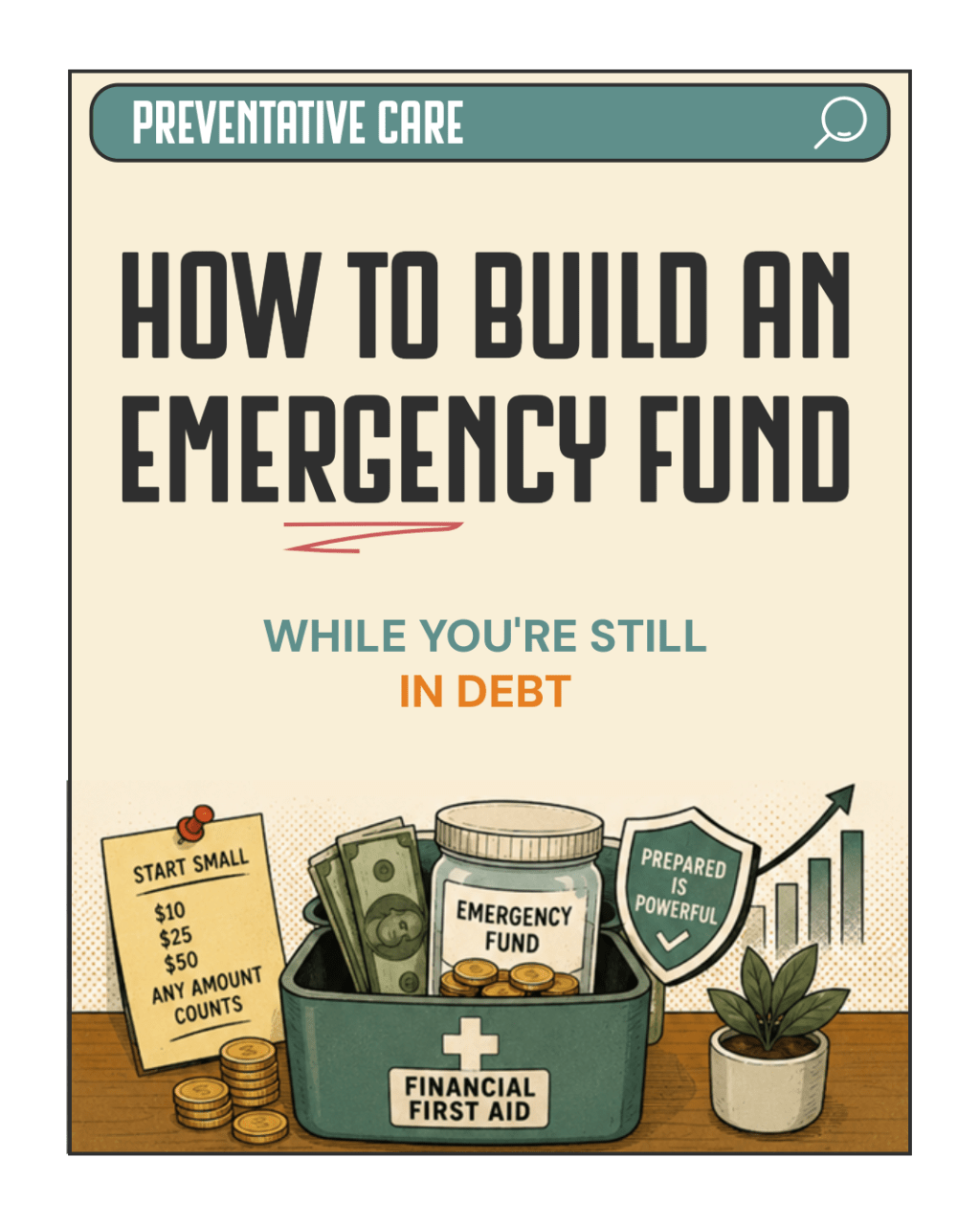
A lot of financial advice treats debt and savings like they exist on opposite sides of a battlefield.
Pay off debt first.
Save first.
Invest first.
Cut every luxury immediately.
Never buy coffee again until retirement.
Very peaceful. Very reasonable. Absolutely not stressful at all.
But real life rarely works that neatly.
When you’re dealing with student loans, credit cards, car payments, medical bills, rising grocery costs, or the general financial jump scares of adulthood, having no savings can make even small emergencies feel catastrophic. One unexpected expense can undo months of progress and send you right back into the debt cycle you were trying to escape.
That is why building an emergency fund while you still have debt is not a contradiction.
It is preventative care.
An emergency fund is not about becoming financially perfect. It is about creating enough breathing room that one bad week does not become a long-term financial setback.
Symptom
“I’m trying to pay off debt, but every emergency ends up back on a credit card.”
This is one of the most frustrating debt cycles because you can be doing the “right” things and still feel like you are getting nowhere.
You make a payment.
You feel responsible for roughly 11 minutes.
Then your tire gives up, your pet needs a vet visit, your utility bill acts suspicious, or your house produces a new repair with the confidence of a subscription service.
Suddenly, the credit card comes back out.
For a lot of people, this is not really an overspending problem. It is an instability problem. When there is no cash buffer, debt becomes the emergency fund by default.
Diagnosis
The problem is not that you are trying to save while in debt.
The problem is trying to pay off debt with no protection from the next surprise expense.
Without emergency savings, unexpected costs often end up on credit cards, buy-now-pay-later plans, overdrafts, delayed bills, or other expensive forms of “I’ll deal with this later.”
That can create a loop:
| What Happens | Why It Keeps You Stuck |
|---|---|
| You make extra debt payments | Progress starts to build. |
| An emergency happens | You have no cash buffer. |
| You use credit again | The balance goes back up. |
| You feel discouraged | Motivation drops. |
| You restart the cycle | Progress feels invisible. |
This is why a small starter emergency fund can matter even before your debt is gone.
The goal is not to save six months of expenses overnight. The goal is to create enough space between you and the next minor financial disaster.
A $500 emergency fund will not solve every problem, but it can stop smaller problems from turning into new debt.
Treatment Plan
Start Smaller Than You Think
A lot of people avoid building emergency savings because the recommended numbers feel impossible.
Six months of expenses sounds wonderful in theory. In real life, if you are already stretched thin, hearing “just save $20,000” is about as helpful as being told to simply become a woodland duchess with passive income.
Start smaller.
A starter emergency fund might be $250, $500, $1,000, one paycheck, or one month of essential expenses. The right first goal depends on your income, debt, household needs, and how often surprise expenses tend to appear.
| Starter Goal | Good For |
|---|---|
| $250 | A first buffer if money is extremely tight. |
| $500 | Smaller emergencies like copays, minor repairs, or utility spikes. |
| $1,000 | A stronger cushion for car repairs, medical bills, or household issues. |
| One paycheck | Helps protect cash flow timing. |
| One month of essentials | A longer-term stability goal. |
The first goal is not wealth.
The first goal is interruption prevention.
Automate a Small Amount
If saving depends on whatever is “left over,” there may never be anything left over. Money has a way of evaporating into groceries, gas, fees, and one innocent little online order that apparently invited friends.
Try making the amount small enough that it does not wreck the rest of your budget.
That might be $5 a week, $10 per paycheck, $25 a month, round-ups from purchases, part of a tax refund, or a small portion of side income.
The amount matters less than building the habit.
Small savings do not feel dramatic, but they quietly change what happens when something goes wrong.
Keep Emergency Savings Separate
One mistake people make is keeping emergency savings mixed into the same account they use for everyday spending.
If the money sits beside groceries, bills, subscriptions, and random debit card purchases, it becomes very easy to “borrow” from it temporarily. Temporarily, of course, in the same way laundry is temporarily sitting in the dryer for four days.
A separate savings account creates a boundary.
Some people even nickname the account something specific, like:
| Account Name | Why It Works |
|---|---|
| Emergency Fund | Clear and boring, which is useful. |
| Financial Buffer | Reminds you what the money is for. |
| Please Don’t Touch | Direct. Slightly dramatic. Effective. |
| Things Will Eventually Break | Unfortunately accurate. |
The goal is to make the money available when needed, but not so visible that it becomes part of everyday spending.
Decide What Counts as an Emergency
Not every inconvenience is an emergency.
An emergency fund is usually for urgent, necessary, unexpected expenses. Things like medical costs, car repairs, essential home repairs, income interruptions, pet emergencies, or unavoidable travel.
It is generally not for boredom shopping, stress purchases, impulse upgrades, “it was on sale,” or emotionally sponsored online checkout decisions.
A simple way to decide:
| Question | If Yes |
|---|---|
| Is it unexpected? | It might qualify. |
| Is it necessary? | It might qualify. |
| Is it urgent? | It might qualify. |
| Will ignoring it create a bigger problem? | It probably qualifies. |
| Do I just want it because life is exhausting? | Probably not emergency fund territory. Annoying, but true. |
The point of an emergency fund is to reduce future instability, not create a secret second checking account with better branding.
Balance Saving and Debt Payoff
This is where people tend to get stuck.
Should you save first or pay off debt first?
The irritating but honest answer is: it depends.
If you have high-interest credit card debt, it makes sense to care about interest. But if you have no emergency savings at all, throwing every spare dollar at debt can leave you exposed. Then one surprise expense sends you right back to the card.
A balanced approach might look like this:
| Situation | Possible Approach |
|---|---|
| No emergency savings at all | Build a small starter fund first. |
| High-interest credit card debt | Save a small buffer, then focus hard on payoff. |
| Unstable income | Keep more cash available before aggressive debt payoff. |
| Older car or home repairs likely | Use sinking funds along with emergency savings. |
| Student loans with manageable payments | Build stability while making required payments. |
| Frequent surprise expenses | Identify which “emergencies” are actually predictable. |
Financial progress is not just about math. It is also about resilience.
A completely empty savings account can make even minor financial problems feel emotionally overwhelming.
Things to Monitor
As your emergency fund grows, pay attention to the patterns behind your emergencies.
Some surprise expenses are truly random. Others are recurring costs wearing a fake mustache.
| Monitor This | What It Can Tell You |
|---|---|
| How often emergencies happen | Whether your buffer needs to be bigger. |
| What emergencies usually cost | Helps set a realistic savings goal. |
| Credit card use | Shows whether the emergency fund is reducing new debt. |
| Overdrafts or late fees | May point to cash flow timing issues. |
| Car, pet, medical, or home costs | May need separate sinking funds. |
| Emotional spending triggers | Helps separate stress spending from true emergencies. |
Sometimes preventative care is not about eliminating problems entirely. It is about making sure the next problem does less damage than the last one.
Final Diagnosis
Emergency funds are often discussed like a financial milestone, but for many people they function more like stress-reduction infrastructure.
They create flexibility, recovery time, fewer panic decisions, and fewer moments where one expense threatens the entire month.
You do not have to choose between saving money and paying off debt forever. But if every emergency keeps sending you back into more debt, a small cash buffer may be one of the most important parts of your payoff plan.
Progress does not have to look dramatic to matter.
Sometimes financial improvement starts with making sure the next emergency does not get to bring the whole budget down with it.
Related Articles to Check Out
| Article | Why It Helps |
|---|---|
| Debt Snowball vs. Debt Avalanche: Which Payoff Method Actually Works Better? | Helps you decide how to prioritize debt once you have a small buffer. |
| Checklist Before Your Student Loan Payment Restarts | Useful if student loan payments are coming back into your monthly budget. |
| Navigating Payments: When Student Loans Don’t Decrease | Explains why debt progress can feel slow even when you are making payments. |
| Building a Life While You Still Have Student Debt | A broader reminder that debt payoff does not mean putting your entire life on pause. |
 Side Effects Include Debt
Leave a comment