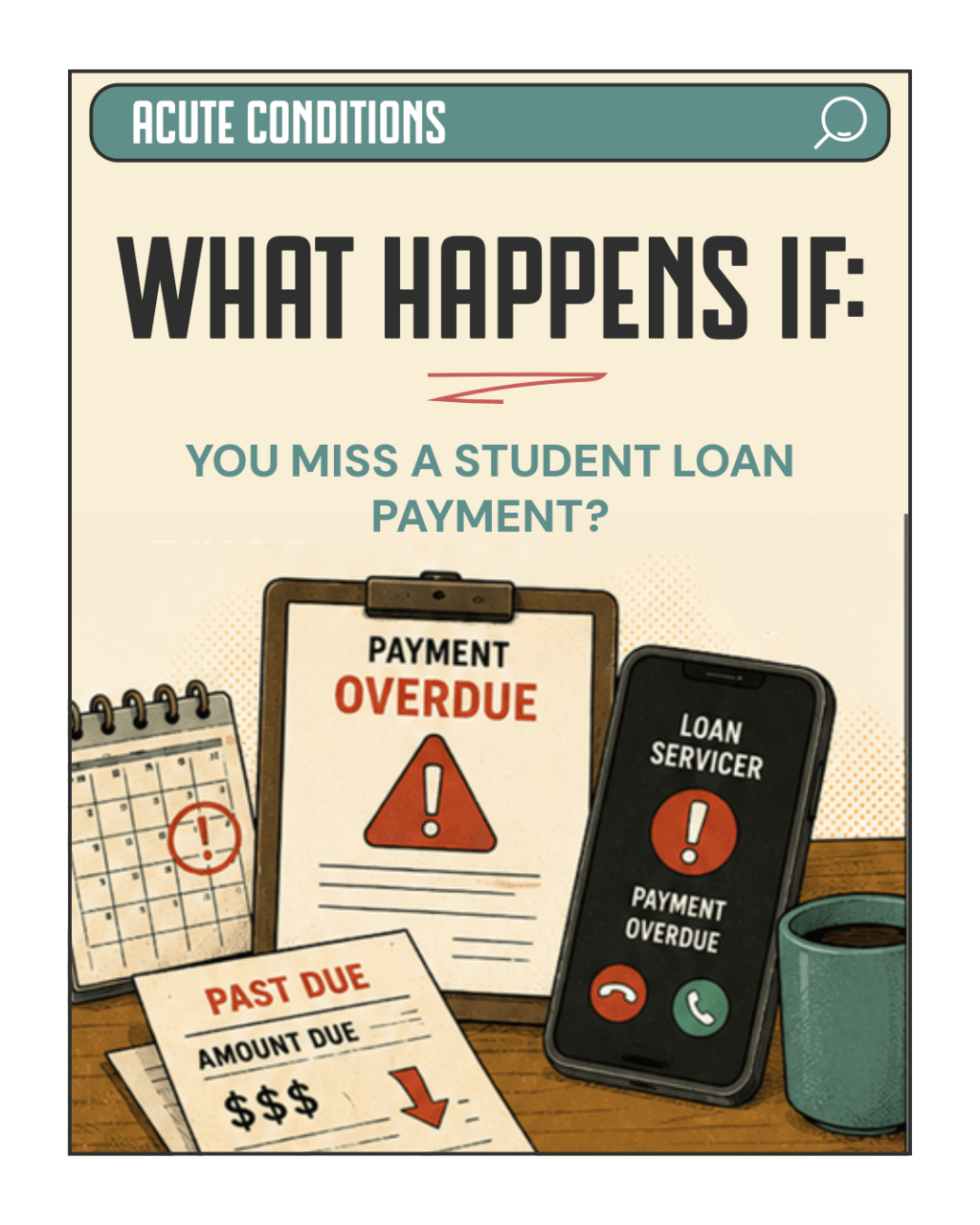
Missing a student loan payment can feel like one of those moments where your stomach drops before your brain catches up.
Maybe your paycheck was smaller than expected. Maybe rent exploded. Maybe you opened your loan servicer account, saw the payment amount, and quietly closed the tab like it contained ancient curses.
The good news is that one missed payment usually does not trigger immediate financial collapse. Student loans tend to move through stages, and understanding those stages can help you avoid making a stressful situation even worse.
For federal student loans, a missed payment usually makes the loan delinquent first. Federal Student Aid says federal student loans generally go into default after 270 days of nonpayment, and delinquency may be reported to credit bureaus once a loan is 90 days or more past due.
Private student loans can move differently depending on the lender and contract, so it matters a lot whether your loans are federal, private, or both.
Missing one payment is serious, but it is usually not the same thing as immediate default.
Symptom
“I missed a student loan payment, and now I’m worried everything is about to fall apart.”
This is a very normal reaction. Money stress has a way of turning one missed payment into a full mental slideshow of ruined credit, collection calls, wage garnishment, and living under a bridge with a suspiciously judgmental raccoon.
But the actual process usually has stages.
The problem is that most borrowers do not know what happens at each stage, so the fear gets louder than the facts.
Common side effects may include avoiding your servicer account, ignoring emails because you are not emotionally prepared for the subject line, checking your credit score like it is a medical monitor, or convincing yourself that if you do not look at the problem, maybe the problem will respect your privacy.
It will not. Rude, but true.
Diagnosis
A missed student loan payment usually starts with delinquency.
For federal student loans, delinquency begins when you miss a payment. The loan does not usually go straight into default. Federal Student Aid explains that federal student loans normally become delinquent after a missed payment, may be reported to credit bureaus after 90 days or more, and go into default after 270 days of nonpayment.
Here is the plain-English version:
| Stage | What It Usually Means |
|---|---|
| Missed due date | Your payment was not made on time. |
| Delinquency | Your account is past due. |
| 90+ days delinquent | Federal loans may be reported to credit bureaus. |
| 270 days nonpayment | Most federal student loans enter default. |
| Default | Serious collection consequences can begin. |
That timeline is mostly about federal student loans. Private student loans can have stricter terms, faster reporting, and fewer built-in protections. If you have private loans, check your loan agreement or contact the lender directly.
What Happens Right Away?
At first, not much may seem to happen.
You may get reminder emails, texts, letters, or calls from your servicer. Your account may show as past due. Interest may continue building. Your balance may not politely freeze itself in place while you figure things out.
That would be considerate, but student loan balances are not known for emotional intelligence.
If the missed payment is recent, the most important thing is to log into your official servicer account and confirm exactly what is showing.
| What to Check | Why It Matters |
|---|---|
| Amount past due | Tells you what must be caught up. |
| Current due date | Helps you avoid missing the next one too. |
| Repayment plan | Your payment may not fit your current income. |
| Interest accrual | Explains why the balance may keep growing. |
| Available options | You may qualify for IDR, deferment, or forbearance. |
Do not rely only on memory, old emails, or panic. Your account dashboard is the starting point, even if opening it feels like touching a cursed artifact.
Your Balance Can Keep Growing
Missing a payment does not usually freeze the debt in place like a mosquito trapped in amber.
Interest can continue to accrue, which means your balance may increase, future payments may cover mostly interest, and repayment can take longer. Federal Student Aid also notes that interest may still accrue during deferment or forbearance, and those options can affect forgiveness programs.
This is one reason borrowers feel stuck. Even when they are trying to recover, the math keeps moving in the background like it has somewhere to be.
A missed payment can create two problems at once: the past-due amount and the interest that keeps building.
When Late Payments Affect Credit
For federal student loans, late payments are generally reported once the loan is 90 days or more past due. MOHELA’s federal student loan credit reporting guidance says Department of Education-owned loans begin being reported delinquent once they are 90 days or more past due on the last day of the month.
Once a late payment is reported, your credit score may drop. The exact impact depends on your credit history, but missed payments can affect future borrowing and applications.
| Credit Area | Possible Impact |
|---|---|
| Credit score | May decrease after late reporting. |
| Apartment applications | Landlords may review credit history. |
| Car loans | Approval or rates may be affected. |
| Credit cards | Limits, approvals, or rates may change. |
| Refinancing | Lower credit can make better rates harder to get. |
This is why acting early matters. A payment that is a few days late is not the same situation as a payment that is several months late.
What Happens If Federal Loans Go Into Default?
Federal student loan default is more serious.
Federal Student Aid says federal student loans generally enter default after at least 270 days without payment. After default, the loan may be transferred to the Department of Education’s Default Resolution Group or, for some FFEL loans, a guaranty agency. If default is not resolved, involuntary collections such as wage garnishment and Treasury offset may eventually begin.
Possible consequences can include:
| Default Consequence | What It Means |
|---|---|
| Credit damage | Default can hurt your credit history. |
| Collection fees | Extra costs may be added. |
| Wage garnishment | Money may be taken from your paycheck. |
| Tax refund withholding | Federal payments may be intercepted. |
| Loss of aid eligibility | You may lose access to some federal student aid. |
| Fewer repayment options | You may need to resolve default before returning to normal repayment. |
The government has collection powers that work a little like a raccoon with opposable thumbs. Surprisingly persistent. Difficult to ignore. Somehow already in the cabinet.
Still, even default is not always permanent. Federal Student Aid explains that loan rehabilitation may help borrowers get out of default, stop collections, and regain eligibility for federal student aid after completing the process.
Private Student Loans Work Differently
Private student loans are their own separate creature.
They do not usually come with the same federal protections, income-driven repayment options, or broad forgiveness programs. Depending on the lender, private loans may be reported late sooner, sent to collections faster, or handled more aggressively.
If you have private loans, check the contract and contact the lender before assuming the federal timeline applies.
| Federal Student Loans | Private Student Loans |
|---|---|
| Often have IDR options | Usually do not have federal IDR protections. |
| Default usually after 270 days | Default timeline depends on lender terms. |
| May offer deferment or forbearance | Hardship options vary by lender. |
| Federal rehabilitation may apply after default | No universal federal rehabilitation process. |
| Serviced through federal loan servicers | Managed by private lenders or servicers. |
Knowing your loan type is not a minor detail. It changes the whole treatment plan.
Treatment Plan
Act Before the Missed Payment Gets Older
The sooner you respond, the more options you usually have.
If you missed a payment recently, log into your servicer account and check the amount past due. Then look at whether you can make the payment, make a partial payment, change your repayment plan, or request temporary relief.
You do not need to solve your entire financial life in one sitting. Start with the immediate question: what has to happen to stop this from getting worse?
Early action is usually less painful than waiting until the loan system starts escalating.
Contact Your Servicer
Servicers are not always fun to deal with, but your official servicer is still the place to verify your actual options.
Ask about income-driven repayment, deferment, forbearance, hardship options, payment recalculation, and whether your account is at risk of credit reporting.
If you call, take notes. Write down the date, time, representative name if available, and what they told you. If you use secure messages, save copies.
Student loan systems occasionally behave like group projects with federal consequences, so documentation matters.
Consider Income-Driven Repayment
If your federal student loan payment is too high for your income, an income-driven repayment plan may help lower the monthly amount. This is especially important if the missed payment happened because the payment no longer fits your budget.
IDR is not always the cheapest long-term option, but it may help prevent delinquency from turning into default.
| IDR May Help If… | Why |
|---|---|
| Your income dropped | Payments may adjust based on income. |
| Your payment is unaffordable | Lower payments may reduce delinquency risk. |
| You are pursuing forgiveness | IDR may be part of a long-term strategy. |
| You need cash flow stability | A manageable payment is better than repeated missed payments. |
Use Deferment or Forbearance Carefully
Deferment or forbearance may help temporarily if you cannot make payments, but they are not magic pause buttons.
Interest may still accrue in some situations, and these options may affect forgiveness progress depending on the program and loan status. Federal Student Aid recommends contacting your servicer if you need temporary relief and using tools like Loan Simulator to understand how deferment or forbearance could affect your loans.
A pause can be useful. Just make sure you understand what happens during the pause.
Avoid Scam “Relief” Companies
When people miss payments, scam companies smell panic in the air.
Be careful with anyone promising instant forgiveness, secret programs, urgent enrollment, or guaranteed results if you pay a fee. Student loan confusion is basically scam fertilizer.
Use your official servicer and StudentAid.gov before giving information or money to anyone.
Things to Monitor
Once a payment has been missed, the goal is to keep the situation from quietly getting worse in the background.
| Monitor This | Why It Matters |
|---|---|
| Days past due | Helps you understand credit reporting and default risk. |
| Credit reporting status | Federal loans may be reported after 90 days delinquent. |
| Interest accrual | Explains balance growth. |
| Payment amount | May need adjustment if it is unaffordable. |
| Repayment plan | Your current plan may not fit your situation. |
| Servicer messages | Notices may include deadlines or options. |
| Scam calls or emails | Missed payments can make borrowers more vulnerable. |
| Documentation | Helps if information changes or errors appear. |
This is one of those times when a boring checklist is more useful than a dramatic panic spiral. Deeply unfair, but here we are.
Final Diagnosis
Missing one student loan payment does not mean you failed.
It means something in your financial system did not work this month. Maybe your payment was too high. Maybe your income changed. Maybe another bill took priority. Maybe modern living expenses did their usual little tap dance across your budget.
Missing a payment is serious, but it is usually manageable if you respond early.
The real danger is avoidance. A missed payment can become delinquency, delinquency can become credit damage, and long-term nonpayment can eventually become default.
So the treatment is not shame.
The treatment is information, action, and a plan before the problem gets larger.
Related Articles to Check Out
| Article | Why It Helps |
|---|---|
| Checklist Before Your Student Loan Payment Restarts | Helps you review account status, payment amount, interest, and due dates before repayment starts. |
| Navigating Payments: When Student Loans Don’t Decrease | Explains why balances can keep growing even when payments happen. |
| How to Build an Emergency Fund While You’re Still in Debt | Helps prevent future missed payments from surprise expenses. |
| “Your Loans Qualify”: How Student Loan Scam Calls Work | Helps you avoid scam companies that target borrowers under stress. |
 Side Effects Include Debt
Leave a comment