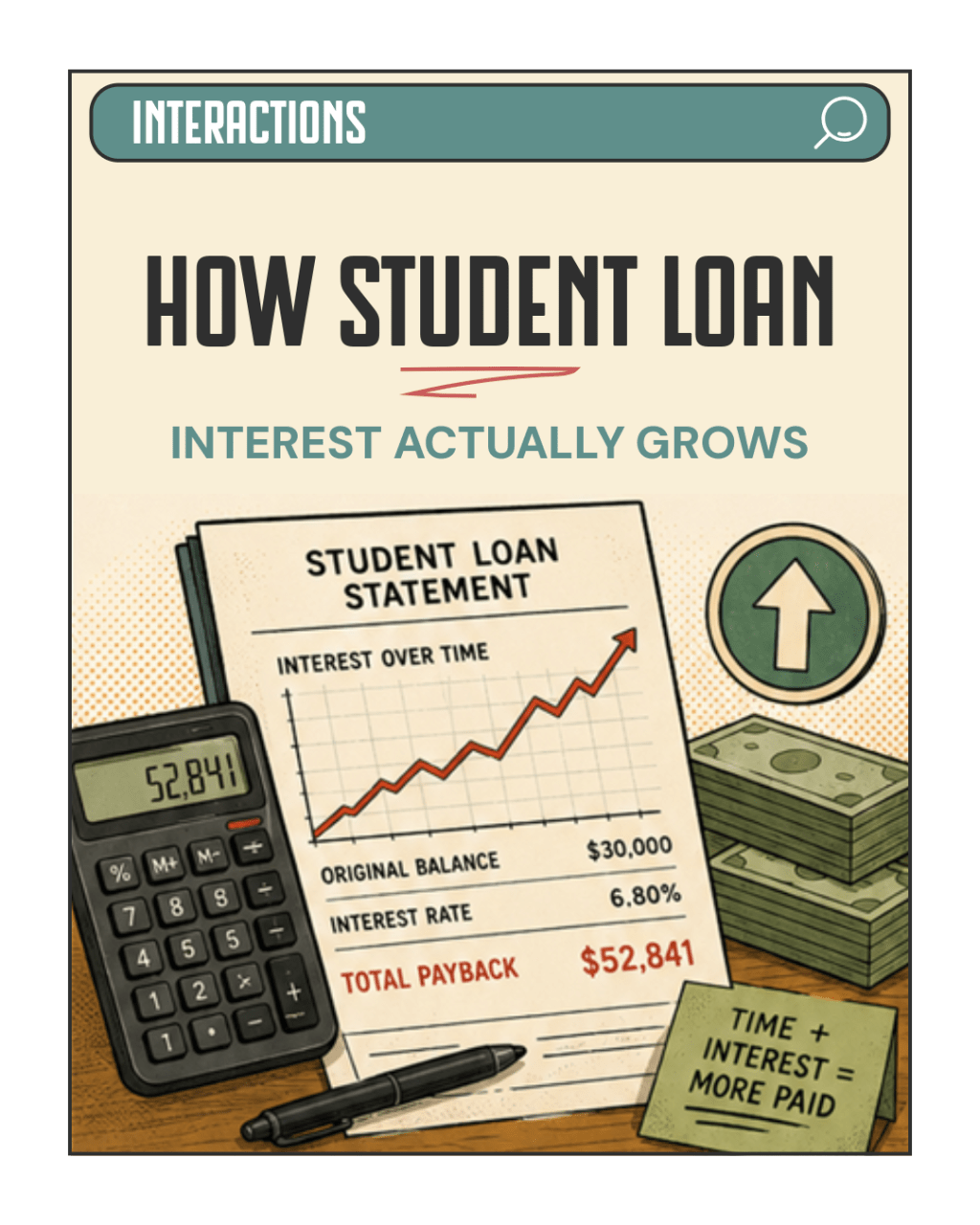
Student loan interest is one of those things that sounds simple until you try to calculate what it is doing to your actual balance.
You borrowed money.
Interest gets added.
You make payments.
The balance should go down.
Nice little story. Very tidy. Almost suspiciously tidy.
In real life, student loan interest can feel much more confusing because it usually builds daily, payments often go to interest before principal, and certain repayment statuses can make the balance behave in ways that feel personally rude.
This article is the deeper explanation behind why student loan balances sometimes do not decrease the way borrowers expect.
Interest is not just a percentage sitting quietly on your account. It is usually building every day in the background.
Symptom
“My student loan balance keeps changing, and I do not understand why.”
This can show up in a few different ways.
Maybe your balance increases between payments. Maybe your payment posts, but the principal barely changes. Maybe your account shows interest building even during a pause. Or maybe you are trying to compare repayment plans and keep running into words like “accrual,” “capitalization,” and “principal,” which sounds less like financial literacy and more like a vocabulary quiz with consequences.
Common side effects may include staring at your loan dashboard, wondering why your payment barely made a dent, assuming the math is fake, or deciding that student loan interest was created in a basement by someone who owns too many calculators.
Diagnosis
Most federal student loans use simple daily interest. That means interest is usually calculated each day based on your unpaid principal balance, not on interest that has already accrued. Edfinancial, a federal student loan servicer, explains the formula this way: current principal balance multiplied by the interest rate, divided by 365.25, equals daily interest.
In plain English:
| Term | Meaning |
|---|---|
| Principal | The original loan amount you borrowed, plus any capitalized interest. |
| Interest rate | The percentage charged for borrowing the money. |
| Daily interest | The amount of interest your loan builds each day. |
| Accrued interest | Interest that has built up but has not been paid yet. |
| Capitalized interest | Unpaid interest that gets added to your principal balance. |
Here is the basic formula:
| Step | Example |
|---|---|
| Principal balance | $47,586 |
| Interest rate | 6% |
| Formula | $47,586 × 0.06 ÷ 365.25 |
| Daily interest | About $7.82 per day |
| 30-day estimate | About $234.60 |
That does not mean every account will match this exact number, because your actual loans may have different balances, interest rates, subsidies, statuses, and payment dates. But the formula helps explain why interest keeps showing up like a tiny financial houseguest who refuses to leave.
How Daily Interest Turns Into Monthly Frustration
Daily interest does not wait for your monthly bill to feel official.
It builds day by day. Then when you make a payment, the payment usually goes toward outstanding interest first. After that, whatever is left goes toward principal. Edfinancial explains that when a payment is received, it is applied to accrued interest first, and the remainder is applied to principal.
That is why a payment can leave your bank account without shrinking your balance much.
For example:
| Monthly Example | Amount |
|---|---|
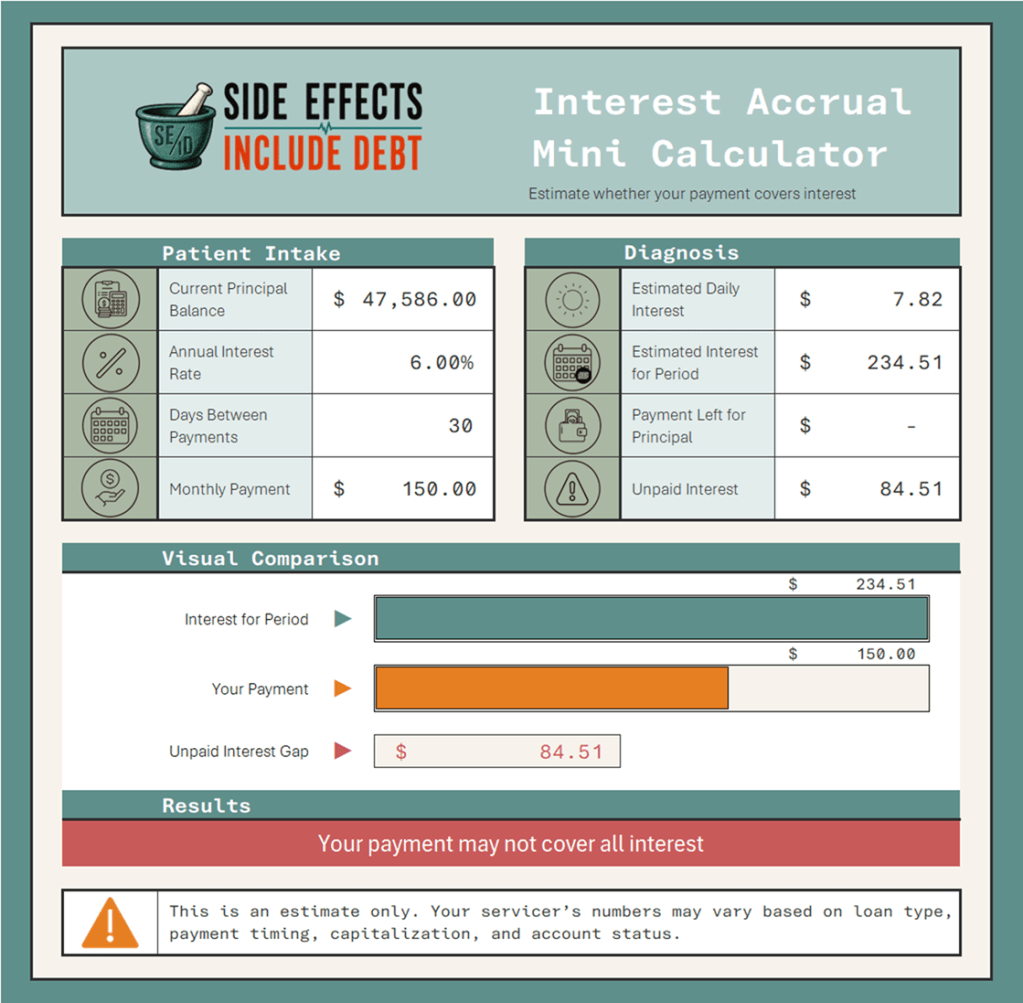
| Loan balance | $47,586 |
| Interest rate | 6% |
| Approximate monthly interest | $234.60 |
| Monthly payment | $150.00 |
| Amount left for principal | $0.00 |
| Unpaid interest | About $84.60 |
In that example, the borrower made a real payment. The payment helped. But it did not cover all the interest that built during the month, so the principal did not decrease.
This is the part that makes people feel like their money fell into a trapdoor.
A payment can be successful and still not reduce principal if interest eats the whole thing first.
Why Interest Accrual Feels Invisible
Interest does not always announce itself clearly.
It may show up as a separate line in your account. It may be buried in loan details. It may appear differently depending on your servicer dashboard. Some borrowers only notice it when the total balance starts creeping up.
That makes interest feel sneaky, even when it is technically following the loan terms.
The confusion gets worse when your payment amount changes, your loans enter or leave forbearance, your repayment plan shifts, or your due date changes. The number of days between payments can also affect how much interest accrues before the next payment.
| Why Interest Amounts Change | What It Means |
|---|---|
| Different number of days between payments | More days usually means more interest. |
| Different interest rates across loans | Each loan may grow at a different pace. |
| Payment does not cover interest | Principal may not decrease. |
| Forbearance or deferment | Interest may continue depending on loan type and status. |
| Capitalization | Future interest may be based on a larger principal balance. |
This is why looking only at the monthly payment does not tell the full story. You also need to know how much interest is building between payments.
Capitalization: When Interest Becomes Principal
Capitalization is when unpaid interest gets added to your principal balance.
That matters because future interest may then be calculated on the new, larger principal. Federal Student Aid defines interest capitalization as unpaid interest being added to a loan’s principal balance, which can increase the overall cost of the loan and monthly payments because interest grows on the larger balance.
A simple example:
| Before Capitalization | Amount |
|---|---|
| Principal balance | $47,586 |
| Unpaid interest | $1,000 |
| New principal after capitalization | $48,586 |
After that, interest is calculated on $48,586 instead of $47,586.
That may not sound dramatic at first, but over time it can increase the total cost of the loan. It is basically interest putting on a fake mustache and joining the principal.
Very legal. Very annoying.
Treatment Plan
Find Your Daily Interest Amount
Start by calculating your approximate daily interest.
Use this formula:
Principal balance × interest rate ÷ 365.25 = daily interest
For example:
$47,586 × 0.06 ÷ 365.25 = about $7.82 per day
Then multiply that by the number of days between payments.
| Days Between Payments | Approximate Interest |
|---|---|
| 15 days | $117.30 |
| 30 days | $234.60 |
| 31 days | $242.42 |
| 45 days | $351.90 |
This is why your payment timing matters. A longer gap between payments can mean more interest has built up before the next payment is applied.
Compare Your Payment to Monthly Interest
Once you estimate your monthly interest, compare it to your payment.
| If Your Payment Is… | What May Happen |
|---|---|
| More than monthly interest | Some money may reduce principal. |
| About equal to monthly interest | Balance may barely move. |
| Less than monthly interest | Balance may stay flat or grow. |
| $0 during interest accrual | Interest may build in the background. |
This does not automatically mean your repayment plan is wrong. If you are pursuing forgiveness or using an income-driven repayment plan for affordability, a lower payment may be part of the strategy.
But you should know what the tradeoff is.
The lowest payment may help your monthly budget, but it may not be designed to reduce your balance quickly.
Check Which Loans Are Subsidized
Subsidized and unsubsidized loans do not always behave the same way.
For some subsidized federal loans, the borrower may not be responsible for interest during certain in-school, grace, or deferment periods. Edfinancial notes that borrowers are generally not responsible for interest on Direct Subsidized and FFELP Subsidized Loans during in-school and grace periods or other deferment periods.
Unsubsidized loans, Parent PLUS loans, and Grad PLUS loans are different. Interest may accrue even when payments are not required.
So when you check your account, do not just look at the total balance. Look at the loan type.
| Loan Type | Why It Matters |
|---|---|
| Subsidized federal loans | May have interest benefits during certain periods. |
| Unsubsidized federal loans | Interest often accrues during school, grace, deferment, or forbearance. |
| Parent PLUS / Grad PLUS | Interest generally accrues and can add up quickly. |
| Private student loans | Rules depend on the lender and contract. |
Watch For Capitalization Events
Capitalization can make the loan more expensive, so it is worth knowing when it may happen.
It may occur after certain periods of deferment, forbearance, consolidation, or changes in repayment status, depending on the loan type and current rules. Edfinancial explains that accrued interest is usually capitalized when a loan goes into repayment and that capitalization increases the total cost of the loan.
The key question is:
“Will unpaid interest be added to my principal?”
That is the thing to confirm before making big repayment decisions.
Use the Interest Accrual Mini Calculator
Things to Monitor
Student loan interest does not need constant surveillance, but it does need occasional checkups.
| Monitor This | Why It Matters |
|---|---|
| Principal balance | Shows what interest is calculated on. |
| Interest rate | Higher rates grow faster. |
| Daily interest | Helps explain balance movement. |
| Payment amount | Shows whether principal may decrease. |
| Payment date | More days between payments means more accrued interest. |
| Unpaid interest | May affect future balance changes. |
| Capitalization notices | Important because interest may become principal. |
| Loan type | Subsidized, unsubsidized, PLUS, and private loans behave differently. |
| Repayment plan | Some plans prioritize affordability over fast payoff. |
The goal is not to obsess over the balance every day. The goal is to understand what the balance is doing and why.
Final Diagnosis
Student loan interest grows because it usually accrues daily on your unpaid principal balance.
That means the balance can change between payments, and your payment may go toward interest before it reduces principal. If your payment does not cover the interest that built up, your balance may barely move or may continue growing. If unpaid interest capitalizes, future interest may be calculated on a larger principal balance.
None of this means you are bad with money.
It means student loan math has layers, and some of those layers are deeply inconvenient.
Once you understand your daily interest, monthly interest, payment amount, and capitalization risk, your loan balance becomes less mysterious. Still annoying, yes. But less mysterious.
Related Articles to Check Out
| Article | Why It Helps |
|---|---|
| Navigating Payments: When Student Loans Don’t Decrease | Explains why payments do not always lower your balance. |
| SAVE vs RAP Explained in Plain English | Helps connect repayment plan changes with interest and payment confusion. |
| Checklist Before Your Student Loan Payment Restarts | Gives you a practical way to check interest, payment amount, and loan status before repayment resumes. |
 Side Effects Include Debt
Leave a comment